Your kid works hard.
Here’s why it’s still not working.
It’s not the swing. It’s not effort. It’s timing — and nobody’s teaching it. That’s what we fix at Better Ball Player.
Good kids. Hard work.
Same results.
Here’s what I hear all the time — from parents who’ve spent real money and players who’ve put in real hours. If any of these sound like your house, you’re in the right place.
It’s not your swing.
It’s your timing.
Here’s the deal — if your kid’s struggling in games, I can almost guarantee their swing isn’t the problem. They’ve been told it is. Coaches have rebuilt it. Maybe multiple times. But the swing isn’t why they’re late on fastballs and frozen on off-speed.
Timing is why. Specifically, the inability to read pitch speed before committing to swing. That’s the skill nobody’s teaching.
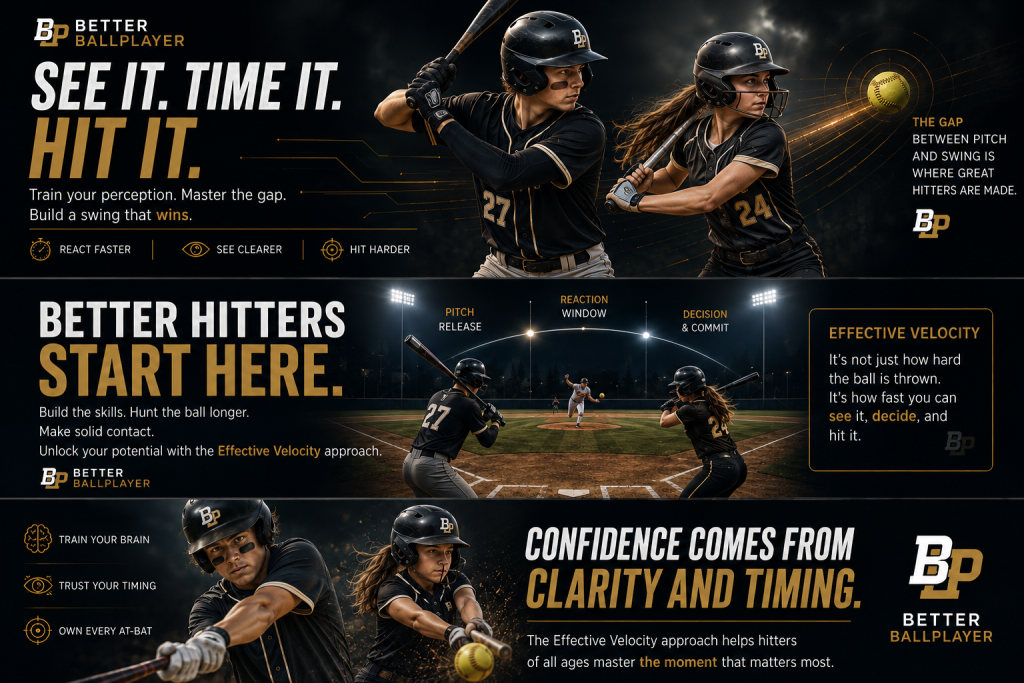
Perry Husband developed a framework called Effective Velocity (EV) that explains exactly how pitch speed — and the perceived speed based on pitch location — creates the gap that beats hitters. We teach hitters to close that gap. That’s it. That’s the whole thing.
Effective Velocity — The Numbers
That’s your window from pitch release to committed swing decision. The mechanics coaches talk about happen after that window. Which is why fixing the swing doesn’t fix the problem.
A pitch inside and up plays 3–5 mph faster than one low and away — even at the same speed off the mound. That gap is what hitters feel as “late” or “frozen.” It’s not a mechanical failure. It’s a perception problem.
We help Brians become Todds.
Every hitter we work with starts as one or the other. Most start as Brian — not because they lack talent, but because nobody ever showed them what timing actually means.
Brian — The Mechanics Hitter
- Looks smooth in the cage, disappears in games
- Hopped between coaches and systems
- Swings the same way, gets the same results
- Pulls the ball off the tee, freezes on off-speed live
- Works incredibly hard — and doesn’t know why it’s not paying off
- Convinced the answer is one more swing adjustment
Todd — The Timing Hitter
- Consistently makes contact in games, not just practice
- Reads pitches early and commits with confidence
- Has a plan at the plate — not a hope
- Handles velocity changes because he sees them coming
- Gets recruited. Gets chosen. Gets counted on.
- Knows the answer isn’t in his swing — it’s in his timing
One framework. Real results.
We don’t rebuild swings. We train hitters to see the ball earlier, decide faster, and commit with confidence. Here’s the process.
Understand the Gap
Learn exactly why hitters get beat — and why it has nothing to do with their mechanics.
Train Your Perception
Build the skill of reading pitch speed before you commit. This is trainable. It’s not a gift.
Apply “Right Now” Timing
Learn Bill’s specific timing cue — the moment of committed decision that changes everything at the plate.
Own the At-Bat
Go from guessing to having a real game plan. Confidence follows when skill leads.
Pick your entry point.
Whether you’re just checking things out or ready to go all-in, there’s a place for you here. No pressure. Start where it makes sense for you.
In the Dugout
- Access to the Better Ball Player community
- EV concepts, timing breakdowns, and coaching content
- Free workshops and live sessions
- The Todd/Brian framework — start understanding the real problem
EV Introduction
- Self-paced mini course — go at your own speed
- The science behind why hitters get beat (from Perry Husband’s EV framework)
- How speed gaps work and what to do about them
- The foundation every hitter needs before any other training
Full Count Membership
- Full access to all BBP content and courses
- Live webinars, Zoom coaching calls, and Q&A sessions
- The active BBP community — players, parents, and coaches all in it together
- “Right Now” timing training — Bill’s core methodology
- $297/year option available (saves over $260)
I’ve watched good kids get failed by this game.
I’ve worked with hundreds of hitters — players who work as hard as anyone you’ve ever seen. And I watched them spin their wheels for years because the coaches around them kept looking at the swing when the problem was somewhere else entirely.
“It’s not your fault. Most hitters are struggling because they believe their swing is broken. But that’s not the real story. Good kids who work hard are still looking lost in games — and today I’m going to show you why. It has little to do with how you make your swing.”
When I found Perry Husband’s Effective Velocity framework, it changed everything I thought I knew about hitting instruction. EV explains why hitters get beat at a fundamental level that mechanics-first coaching never touches. I’ve spent years making that framework accessible — to the 10-year-old in the backyard and the high schooler trying to get recruited.
That’s what Better Ball Player is. A place where timing comes first, mechanics serve timing, and hitters actually get better in games — not just in practice.
Stop chasing mechanics.
Start owning timing.
Join the free community, grab the EV intro course, or go all-in with Full Count. Either way — you’re in the right place now.